What Makes a Facility Covered Under the EEOICPA?
Not every worksite qualifies under the EEOICPA — the program was designed specifically for facilities where workers were exposed to radiation, beryllium, silica, and other toxic substances in connection with the federal government’s nuclear weapons program and related energy research. A facility becomes covered when the Department of Energy, Department of Labor, or the relevant oversight agency formally designates it as a site where occupational illness exposure occurred.
There are several categories of covered facilities under the program. Department of Energy sites are the most common — these are facilities that were directly owned or operated by the DOE or its predecessor agencies, including the Atomic Energy Commission (AEC) and the Manhattan Engineer District. Atomic Weapons Employer (AWE) sites are privately owned facilities that performed work for the federal government related to atomic weapons production. Beryllium vendor sites are locations where beryllium was processed or fabricated under contract with the DOE.
Workers who were direct government employees, contractors, or subcontractors at any covered facility during the designated coverage period may qualify for benefits — regardless of their specific job title or role. Maintenance workers, custodial staff, security personnel, and construction workers who worked alongside researchers and scientists faced many of the same exposures and are just as eligible to file.
Why the Facility You Worked at Matters for Your Claim
The specific facility where you worked determines several important aspects of your claim. It establishes whether you fall under a Special Exposure Cohort (SEC) designation — which removes the need to prove radiation causation for certain cancers. It affects which coverage period applies to your employment. It shapes what kind of employment documentation the Department of Labor will look for and what federal databases may contain records of your time on site.
Understanding your facility’s coverage status is one of the first things any experienced advocate will assess when reviewing your situation. The facilities listed on this page each have their own operational history, exposure profile, and coverage parameters — and knowing those details is what makes it possible to build the strongest possible claim on your behalf.
Covered Facilities Served by Hallway Healthcare
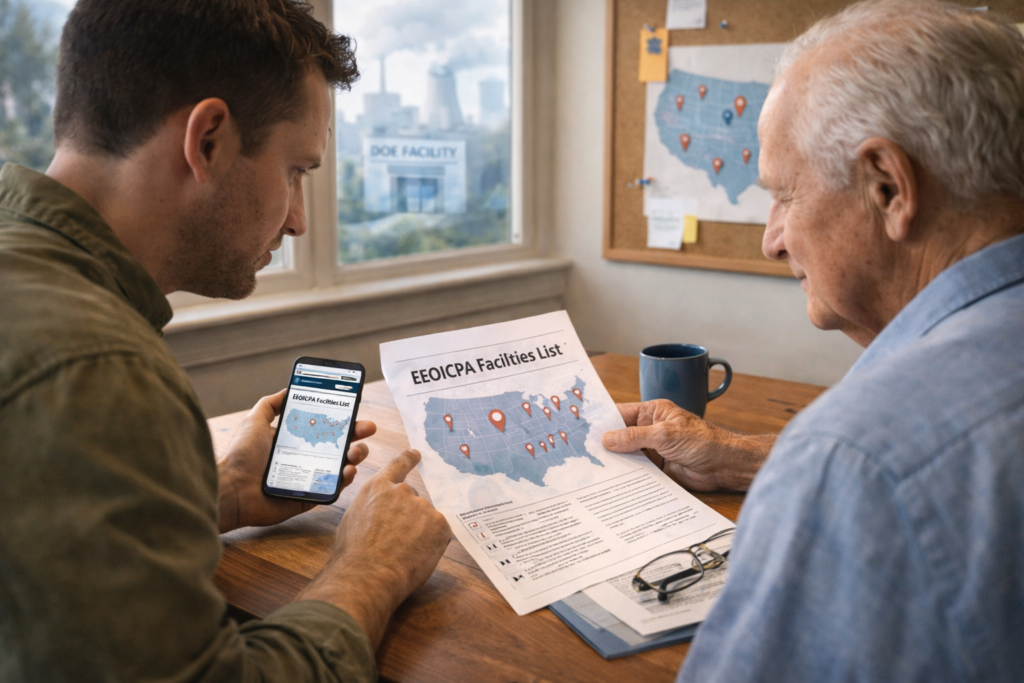
The table below identifies the key facilities for which Hallway Healthcare provides advocacy and in-home healthcare services. Each facility listed is a covered site under the EEOICPA. Click on any facility name to read the full detailed guide for that location.
| Facility Name | Location | Key Facts |
|---|---|---|
| Pacific Northwest National Laboratory | Richland, Washington | Operated by Battelle Memorial Institute; closely connected to the Hanford Site complex; workers exposed to radioactive isotopes, chemical contamination, and Hanford-area environmental hazards |
| Lawrence Berkeley National Laboratory | Berkeley, California | Founded in 1931 by Nobel Prize-winning physicist Ernest Lawrence; played a direct role in Manhattan Project uranium enrichment; SEC dates 1942–1961; beryllium exposure documented on site |
| Lawrence Livermore National Laboratory | Livermore, California | Established in 1952 as a Cold War nuclear weapons research facility; SEC dates 1950–1973; documented tritium, beryllium, and radiation exposures across multiple weapons programs |
| Sandia National Laboratories – California | Livermore, California | Weapons engineering and testing facility; SEC dates 1957–1994; sister site to the Albuquerque campus with overlapping defense research and nuclear weapons development programs |
| General Atomics | La Jolla, California | Formerly a division of General Dynamics; SEC dates 1960–1969; conducted nuclear reactor research and atomic weapons-related work; beryllium exposure documented at the site |
| Atomics International | Santa Susana, California | Operated at the Santa Susana Field Laboratory Area IV; SEC petition active; conducted nuclear reactor development and sodium-cooled reactor research; significant radioactive contamination documented on site |
| Rocky Flats Plant | Golden, Colorado | Primary production facility for plutonium triggers used in nuclear weapons; SEC dates 1952–1983; one of the most contaminated DOE sites in the country; extensive plutonium and beryllium exposure |
| Los Alamos National Laboratory | Los Alamos, New Mexico | Birthplace of the atomic bomb; founded as part of the Manhattan Project in 1943; SEC dates 1943–1975; wide range of radiation, beryllium, and toxic chemical exposures across decades of weapons research |
| Sandia National Laboratories | Albuquerque, New Mexico | Primary nuclear weapons engineering laboratory; SEC dates 1949–1962; responsible for the non-nuclear components of nuclear weapons; extensive testing and hazardous material exposure documented |
| Pantex Plant | Amarillo, Texas | The nation’s primary nuclear weapons assembly and disassembly facility; SEC dates 1951–1991; workers involved in high explosives, radioactive material handling, and weapons component production |
| Oak Ridge National Laboratory | Oak Ridge, Tennessee | One of three original Manhattan Project sites; SEC dates 1943–1955; also known as the X-10 site; conducted early plutonium production and extensive radiochemical research |
| Y-12 National Security Complex | Oak Ridge, Tennessee | Built to enrich uranium for the Manhattan Project; SEC dates 1943–1957; one of the largest uranium processing operations in history; mercury and radiation exposures are well documented |
| K-25 Gaseous Diffusion Plant | Oak Ridge, Tennessee | Constructed as part of the Manhattan Project for uranium enrichment using gaseous diffusion; SEC dates cover the period before February 1992; also known as the East Tennessee Technology Park |
| Savannah River Site | Aiken, South Carolina | Major Cold War production facility for plutonium and tritium; SEC dates 1953–1972; operated five nuclear reactors and two chemical separation facilities; beryllium exposure documented throughout operations |
| Brookhaven National Laboratory | Upton, New York | Major DOE research laboratory on Long Island; SEC dates 1947–1993; conducted nuclear reactor research and high-energy physics; workers exposed to radiation across multiple research programs |
| Knolls Atomic Power Laboratory | Schenectady, New York | Operated under contract with the DOE to develop naval nuclear propulsion systems; workers involved in reactor design, testing, and radioactive material handling across multiple decades of operation |
| Separations Process Research Unit | Schenectady, New York | Early Cold War facility that conducted uranium and plutonium separation research; significant radioactive material handling by workers whose exposures were often poorly documented |
What If You Worked at a Facility Not on This List?
The facilities listed above are the ones for which Hallway Healthcare currently has dedicated resources and guides — but they are not the only facilities covered under the EEOICPA. The program covers hundreds of worksites across the country, and the full list maintained by the Department of Labor is extensive.
If you worked at a DOE facility, an atomic weapons employer site, or a beryllium vendor location that is not listed above, your employment may still qualify you for benefits. The best way to find out is to speak with an advocate who can review your employment history against the full covered facility list and assess whether you qualify. Hallway Healthcare is available to do exactly that at no cost to you or your family.
What to Do If You Think Your Facility Is Covered
Finding your facility on a covered list is just the beginning. Knowing that you worked at a covered site tells you that the door to benefits may be open — but getting through that door requires building a complete and well-supported claim. That means gathering employment records, obtaining medical documentation, understanding which part of the program applies to your situation, and making sure all covered conditions — including consequential conditions connected to your primary illness — are properly identified and included.
It also means understanding your rights if a claim is denied. Many workers who were told they did not qualify, or who received a denial years ago, have had their situations change because the program expanded, a new SEC class was designated, or additional evidence came to light. A prior denial does not have to be the final answer.
How Hallway Healthcare Serves Workers Across These Facilities
Hallway Healthcare provides free advocacy services and in-home nursing care to retired nuclear and federal workers who have been accepted into the EEOICPA program — regardless of which covered facility they worked at. Their team brings facility-specific knowledge to every case, understanding the unique exposure histories, operational periods, and documentation landscapes of each site they serve.
For workers whose accepted conditions qualify for home health services under the program’s medical benefit, Hallway Healthcare provides skilled nursing care, personal care support, and related services entirely covered by the program — with no cost to the worker or their family. Their advocates handle the coordination, the authorization process, and the communication with the Department of Labor so that workers can focus on what matters most.
Conclusion
The facilities listed on this page represent decades of American workers doing dangerous, often classified work in service of their country’s defense and scientific advancement. Many of them came home from those jobs carrying exposures that would not show up as illness for years or even decades. The EEOICPA exists to acknowledge that reality and provide meaningful support to the people who lived it.
If you worked at any of the facilities listed above — or at any other covered DOE site — and have since developed a serious illness, do not wait to find out what you may be entitled to. Reach out to Hallway Healthcare today. Their team will review your situation at no cost, explain your options clearly, and help you take the next step toward the compensation and care you have already earned.